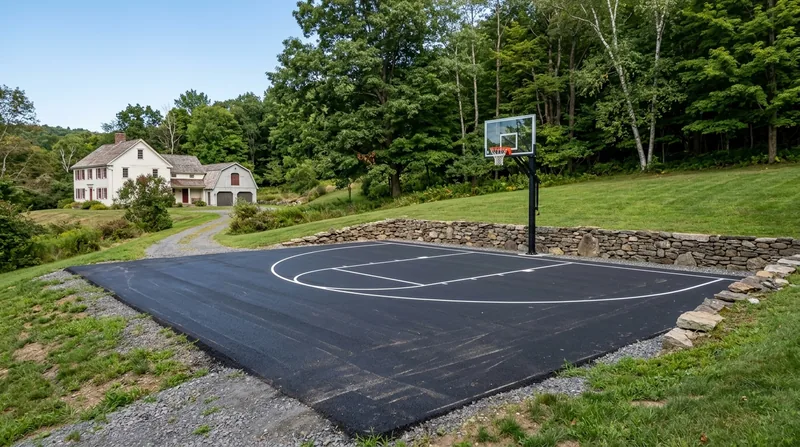




A sports court and path paving project in Syracuse demands more than hot asphalt and a roller. The freeze-thaw cycle that dominates Central New York winters, combined with the drumlin hills and clay-till soils west of the escarpment, means that poor drainage and weak base prep fail within two seasons. Whether you're building a basketball court in Cicero, a tennis surface in Clay, or a walking path on a hillside lot in Camillus, the asphalt sits on top of grading, compaction, and runoff management that determine whether it lasts five years or fifteen. We handle the full scope: site grading for slope and drainage, base preparation and proof rolling, and installation of hot mix asphalt sized for the traffic and play load you expect. The result is a level, durable court or path that sheds water and holds up through the salt-stained winters and green summers that define the Syracuse region.
Why Sports Court and Path Paving Matters in Syracuse's Climate
Syracuse sits in the heart of the Snowbelt, with average annual snowfall exceeding 120 inches and winter temperatures that cycle above and below freezing repeatedly from November through March. This freeze-thaw action is the dominant failure mode for asphalt courts and paths. Water enters small cracks, freezes, expands, and breaks the surface apart into spalling and potholes. Proper drainage prevents that water from pooling in the first place. On sloped lots common throughout Strathmore, Sedgwick Farm, and the neighborhoods south of the escarpment, we grade the court to shed runoff toward the perimeter or into a swale. On flatter sites in Mattydale, DeWitt, and the northern subdivisions of Clay and Cicero, we build crown and slope into the asphalt itself, then compact a dense base that resists heave from the clay and till soils beneath.
- We measure and grade the site so water runs off, not pools, during spring melt and heavy rain.
- We compact the subgrade and base course to prevent frost heave and settling under play loads.
- We size the asphalt mix for the traffic intensity: thicker, harder mixes for courts with daily use, standard mixes for light-traffic paths.
- We set proper slope and crown so the court drains to the edges and corners, not the center.
A court built this way handles the Onondaga County climate and keeps its surface playable year-round.
Key info: New York State law requires a New York 811 utility locate before any excavation, grading, or site work. Call 811 before we begin, or we will on your behalf. Verify any local permitting requirements with your municipality or HOA, as driveway aprons, curb cuts, and impervious-surface limits vary across Greater Syracuse. See the contact page for a free estimate and guidance on local rules.
How We Build a Sports Court or Path in Syracuse
The work happens in stages, each one critical to the final result. We start with a site visit to assess the existing grade, drainage patterns, tree coverage, and soil conditions. Many Syracuse properties sit under old maples, oaks, and white pines that shade the ground and slow drainage, or on steep hillside lots where water naturally concentrates. We design the grade and base to work with the terrain, not against it. Then we excavate, compact, and proof roll the subgrade, lay the base course to the thickness your court or path requires, and finish with hot mix asphalt. The entire job is measured, documented, and quoted in writing with tonnage and thickness specs.
- We visit the site, measure the area, and assess drainage and existing conditions.
- We call New York 811 for utility locates and confirm local permitting with the city or village.
- We excavate and grade to create proper slope and runoff direction.
- We compact the subgrade and base course in lifts with proof rolling to verify density.
- We lay hot mix asphalt in the thickness and mix design suited to your court or path use.
- We finish with a smooth, level surface ready for line marking or play within 24 to 48 hours.
The result is a court or path that sheds water, resists freeze-thaw damage, and holds up under the play and weather Syracuse throws at it.
Example: A residential basketball court in Baldwinsville on a sloped lot under oak trees required 8 inches of base course, 3 inches of asphalt, and a 2 percent crown to the south. The grading work took two days, the asphalt pour one day. Total cost was within the range for a court that size and site condition. See our pricing page for starting figures and what drives them.
Sports Court and Path Installation Methods
| Approach | Description | Best for |
|---|---|---|
| Full-depth construction on compacted subgrade | Excavate existing material, compact subgrade, lay base course (6 to 10 inches), and finish with hot mix asphalt (3 to 4 inches). | New courts, paths on weak or poor-draining soil, hillside sites requiring significant grading. |
| Overlay on existing compacted base | Mill or remove the top layer of old asphalt, recompact the base, and lay new hot mix asphalt (3 to 4 inches). | Courts or paths with sound base, minimal settlement, good drainage already established. |
| Grading and drainage retrofit | Regrade existing court or path to improve slope and runoff, recompact, and resurface with new asphalt. | Courts with poor drainage or standing water, paths on flat sites, areas with tree root heave or settling. |
| Recycled asphalt millings path | Grade and compact a base of recycled asphalt millings for light-traffic walking paths, no hot mix required. | Informal paths, low-traffic areas, budget-conscious projects, rural or wooded settings. |
Sports Court and Path Paving Cost in Syracuse: What to Expect
A residential sports court and path paving project in Syracuse starts at approximately $8,500 for a standard half-court or short path with straightforward site conditions. That figure covers grading, base prep, compaction, and hot mix asphalt installation on a site with good access and minimal site work. The price moves up with site complexity: steep slopes requiring significant cut and fill, poor drainage requiring swales or perimeter grading, large tree roots or stumps to remove, or thick base courses needed for clay and till soils. A full-size basketball court on a hillside lot in Camillus or Clay may run $12,000 to $18,000 depending on grading and drainage scope. A light-traffic walking path on a flat lot in DeWitt or Cicero may cost less.
The best way to know your actual cost is to get a written estimate on site. We measure the area, assess drainage and soil, and quote the work in writing with tonnage and thickness specs. Every estimate is free and carries no obligation. Call (315) 951-8102 for a same-day or next-day appointment.
Factors that affect cost include the size of the court or path, the slope and grading work required, the depth of base course the soil conditions demand, tree coverage and shade that may slow drainage, proximity to utilities or structures, and the mix design and thickness of asphalt your intended use requires. A court built for daily recreational play needs a harder, thicker mix than a path used once a week. We explain these trade-offs in the estimate and help you choose the right specification for your budget and use case.
Sports Court and Path Paving Near Me: What to Look for in a Syracuse Contractor
Hiring the right paving contractor for a sports court or path is a critical decision. The work is visible, permanent, and sits at the foundation of your property. A contractor who cuts corners on grading or base prep will leave you with a court that drains poorly, cracks in the first winter, or settles unevenly. Honest guidance and local expertise matter more than the lowest bid. Here is what to verify before you hire anyone, including us.
- Ask for a written estimate with the site measured, the base course thickness and tonnage specified, and the asphalt mix and thickness listed.
- Confirm that the contractor understands New York 811 utility locates and will call before any excavation or grading begins.
- Check whether your city or village requires a permit for the work, and whether the contractor will help you navigate the process.
- If you live in an HOA or master-planned community, verify the architectural standards for driveways and outdoor surfaces, as some HOAs restrict asphalt color or require approval before work begins.
- Ask for references from similar projects in Syracuse or nearby towns, and call at least two to ask about drainage, durability, and how the contractor handled site cleanup.
- Verify that the contractor carries liability insurance and ask for a certificate of insurance naming you as additional insured during the work.
A contractor who gives you a detailed, written estimate, explains the work clearly, calls 811 before digging, and carries insurance is someone you can trust. Contact us at https://syracuse-asphalt-paving.com/contact/ for a free estimate and to discuss your specific site and needs.
Sports Court & Path Paving in Syracuse: Pricing Guide
| Service | Price | Details |
|---|---|---|
| Half-court or short path (under 2,000 sq ft) | Starting at $8,500 | Grading, base course, and hot mix asphalt on sites with good access and standard soil conditions |
| Full-size court or longer path (2,000 to 4,000 sq ft) | Starting at $12,000 | Larger area, more base material, and increased grading work on hillside or poor-drainage sites |
| Complex site with significant grading or drainage work | On estimate | Steep slopes, clay soils requiring thick base, tree root removal, or swales and perimeter grading required |
| Recycled asphalt millings path (light-traffic only) | Starting at $3,500 | Grading and compaction of recycled asphalt base without hot mix, suitable for informal or low-use paths |
| Travel and site visits | Included | No separate charge for service calls within Syracuse and surrounding Central New York towns |
| Free estimate | No charge | Written quote with measurements, tonnage, and thickness specs, response within 24 hours at (315) 951-8102 |
Indicative pricing, the exact cost depends on square footage, finish, and site access. Free personalized estimate within 24h at (315) 951-8102.


